Skills & Livelihoods
Digital Literacy in Rural India : Having a Phone is Nearly Not Enough
05th Aug 2026
In a village in Jharkhand, a teenager finishes filling out a scholarship form on a borrowed phone, one she has never used to send an email or open a spreadsheet. She knows how to scroll, share and message. Nobody has ever sat with her and shown her how to search for a job posting, or check if a government scheme is real. This is the half of India’s digital story that never makes it into a press release, the one no subscriber count or download figure will ever capture.
At Mukul Madhav Foundation (MMF), we have come to see digital literacy less as a skill and more as a kind of confidence, the certainty that you can sit in front of a screen and figure things out for yourself. A phone in someone’s hand does not guarantee that confidence. It is entirely possible to own a smartphone and still feel like an outsider every time it is switched on, and that is the gap where rural India’s next generation risks being left behind.
The Hidden Cost of Access Without Skill
India loves to tell its digital story through scale, and the numbers are genuinely impressive. Over 900 million people now use the internet, and broadband coverage nationally sits at 76.3%. But peel back the headline figure, and rural India tells a different story. Only 41.75% of India’s internet users are rural, even though rural India is home to more than 65% of the country’s population. Digital access still bends towards the cities: rural internet penetration stands close to 37%, against 67% in urban India.
Even where access does reach a village, skill often does not follow it in. Just 24% of rural residents report having basic digital skills, compared to 56% in urban India, and the gap widens again for women. Only 24.6% of rural women have ever used the internet, against 48.7% of rural men, a divide that has stubbornly persisted even as phones have become common in almost every home.
Where Digital Skill Meets Opportunity
What changes this picture is not more connectivity. It is someone willing to teach. A study of over 11,000 young unemployed women, trained through India’s National Digital Literacy Mission and the DISHA scheme, found that a modest amount of hands-on computer training genuinely opened doors, better education outcomes, and real employment, for women who had never had either within reach. There is encouraging movement here too. Recent research on rural youth shows the gender gap in digital learning has started narrowing, proof that where someone invests in teaching, the numbers do respond.
One truth holds steady across every village we work in. A device reaches a home in days. A skill takes someone sitting beside you, patiently, more than once.
Our Work on the Ground
Our approach to digital empowerment has grown out of a simple belief: a computer sitting in a classroom means very little without someone there to teach a child, or a grown woman, how to use it without fear.
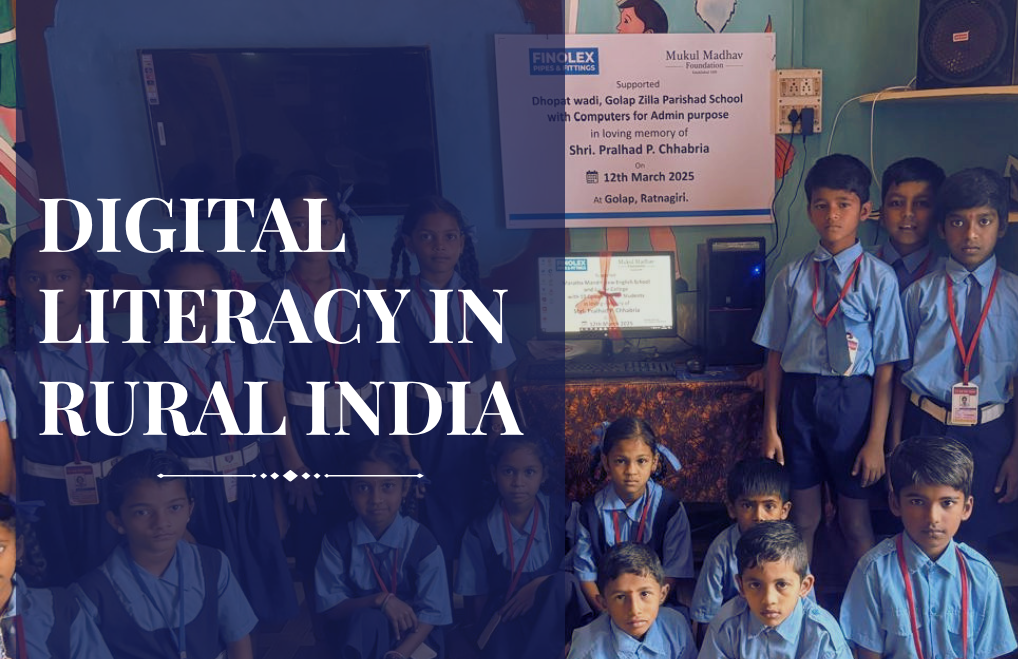
- At Mukul Madhav Vidyalaya in Golap village, Ratnagiri, Maharashtra, we built a computer lab and digital classrooms into the heart of the school, and brought in Robotex India to let students build and tinker with robots, so technology becomes something they make, not just something they read about.
- Our skilling centres in Masar Village, Gujarat, and Ratnagiri, Maharashtra, weave computer literacy into vocational training for more than 5,000 women and 500 youth, many of whom are touching a keyboard for the first time in their lives.
- Through our Aaji Bai Chi Shaala initiative, we sit with older rural women, many of whom have used only a thumb impression in place of a signature for decades, and help them learn enough to bank, transact and verify their own identity without needing to lean on a son or a neighbour.
- Our SRHEYA programme with SEARCH in Gadchiroli and across Maharashtra pairs community health education with digital outreach through the Tarunya-Man-Bhan platform, reaching 1,360 colleges and 1,552 tribal adolescents from Ashram schools, a reminder that a screen works best when it is carrying something a community already trusts, real digital inclusion, not just a device drop.
A Vision Rooted in Readiness
None of this work stands apart from our education or livelihood programmes. It lives inside them, because filling out a form without help, sending money safely, or applying for a job with confidence are not separate skills from reading and writing. They are simply reading and writing, for a newer kind of page.
Closing India’s rural digital divide was never going to be solved by cables and towers alone. BharatNet can lay the fibre to every gram panchayat it reaches, but fibre alone does not teach anyone how to use it. What will actually close this gap is what has always closed gaps in rural India: patient teaching, done by people the community already trusts, repeated for as long as it takes.
Data References
- Class24, “Digital Literacy & Internet Access in India: CAMS Survey 2025” – https://www.class24.study/current-affairs/cams-survey-digital-skills-in-india-2025
- Sambodhi, “Bridging the Digital Divide in Rural India” – https://sambodhi.co.in/bridging-the-digital-divide-in-rural-india/
- Amulya Charan, “The Digital Divide in Education: Bridging the Urban-Rural Gap” – https://www.amulyacharan.com/2024/12/17/the-digital-divide-in-education-bridging-the-urban-rural-gap/
- PMC, “Design and implementation of digital literacy training programme: Findings of a quasi-experimental study from rural India” –https://www.ncbi.nlm.nih.gov/pmc/articles/PMC11984724/
- Ideas For India, “Youth’s digital readiness in rural India” – https://www.ideasforindia.in/topics/human-development/youth-s-digital-readiness-in-rural-india.html