Drinking Water & Sanitation
Water, Wellness, and Literacy: How WASH Infrastructure Improves Health and Education in Rural India
30th June 2026
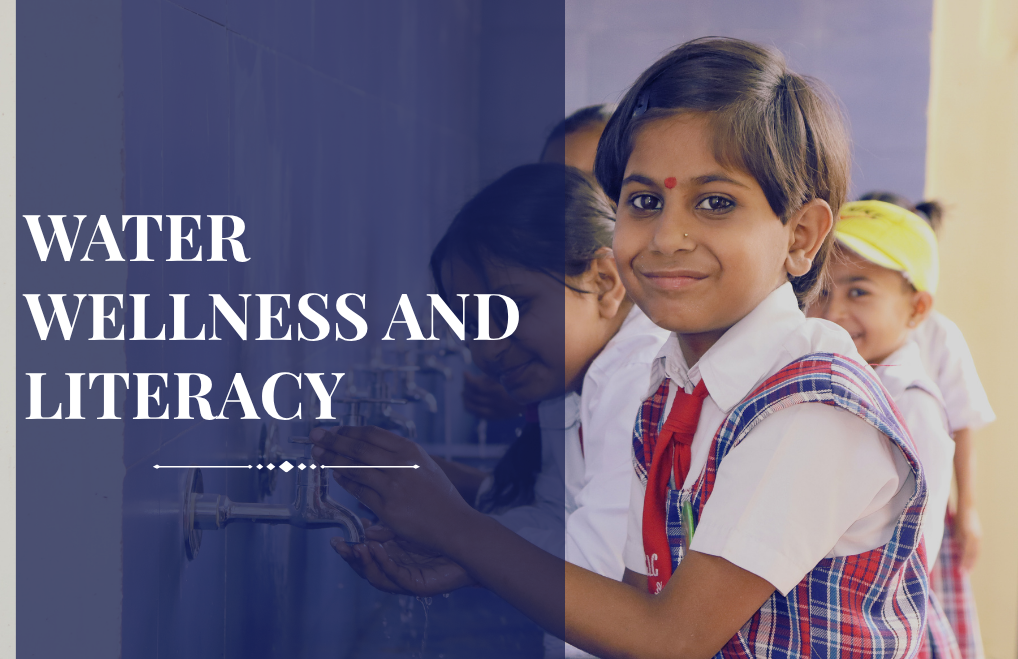
In many villages across rural India, a school day does not begin with a bell. It begins hours earlier, with a long walk to the nearest handpump, an empty pot balanced on a hip, and an unspoken understanding that today might mean missing class altogether. For many children, especially girls, this walk competes directly with the walk to school. And for those who do reach the classroom, the day is often interrupted by something just as basic: a stomach ache from contaminated water, or the absence of a clean, private toilet.
At Mukul Madhav Foundation (MMF), we have come to see clean water access and sanitation and hygiene, together known globally as WASH, not as separate development goals, but as the quiet infrastructure beneath a child’s ability to learn and stay well. The two rarely improve in isolation, which is why every project we take on treats them as connected pieces of the same problem.
The Hidden Cost of Water Scarcity
Despite real national progress, water management in rural areas remains uneven. A 2016 UNICEF analysis found that 54% of rural women spend roughly 35 minutes a day fetching water, the equivalent of 27 lost wage-days a year, with school dropout rates rising by 22% in drought-affected states as children’s time gets pulled toward survival rather than study. By 2022, the WHO-UNICEF Joint Monitoring Programme (JMP) data showed 92% of rural households could reach an improved water source within thirty minutes – real progress – yet roughly 300 million people in rural India still lacked basic sanitation facilities that same year.
This is not only a convenience gap; it is a health one. Contaminated water and inadequate sanitation remain linked to a large share of preventable childhood illness in India, underscoring why water scarcity solutions need to address both supply and behaviour, not infrastructure alone.
Where Water Meets the Classroom
The link between water and learning is increasingly well documented, and the findings are consistently encouraging. A study tracking villages under India’s National Rural Drinking Water Programme between 2004 and 2011 found that better water access lifted school enrolment by 4.5%, improved reading scores, and reduced absenteeism, with girls gaining the most as time once spent fetching water shifted toward homework instead.
More recent evidence reinforces the pattern. A 2024 pilot intervention in Odisha’s Anganwadi centres found that pairing a safe drinking water filter with hygiene education cut infection symptoms among young children from 39% to under 5% in just a few months. Separately, a 2019-20 analysis across Indian states found that improved sanitation access correlated directly with higher literacy and lower school dropout, particularly for girls.
One insight stands out. Water and sanitation upgrades work best when paired with hygiene education and a plan for upkeep. Not as a one-time fix.
Our Work on the Ground
Our approach to clean water access and sanitation and hygiene has grown out of years of on-ground listening. We design each response around what a community is actually missing, not what looks good on paper. The results show up less in numbers and more in the lives the numbers represent.
- We plan drinking water schemes that bring water closer to home: pipelines, borewells, water tankers, and RO filtration units. One such unit serves a girls’ school in Jaisalmer’s Thar desert, where extreme summers leave little margin for error. In Gujarat, schemes at Gametha and Piludra villages now bring reliable water to over 250 families on village outskirts who had none before.
- In Maharashtra, we’ve built individual, solar-illuminated toilets with soak pits, using local labour. This has helped transform 23 villages across Palghar and Gadchiroli into open defecation-free zones.
- Schools have not been left out. We’ve upgraded infrastructure at 52 schools in Ratnagiri and Satara. With Yuva Unstoppable, we brought WASH facilities to 33 schools across four states, reaching 17,129 students in total: Uttar Pradesh (9 schools, 5,491 students), Rajasthan and Bihar (17 schools, 5,543 students), and West Bengal (7 schools, 6,095 students). The result has been steadier daily attendance.
- In Gadchiroli, we’ve remodelled huts once used to isolate menstruating women into Period Positive Holiday Homes. These now support over 1,500 women across 18-plus villages with safety, hygiene, and new livelihood skills.
- Since 2007, water conservation in India through watershed management and rainwater harvesting has helped ease drought across our most water-stressed regions. A rainwater harvesting system across four schools in Padra Block recharges four wells and collects over 500,000 litres of rainwater a year. In Bojadra, an irrigation project has helped 35-plus farmers move from one crop a year to two or three across 50 acres.
A Vision Rooted in Dignity
Across the 15-plus villages MMF has adopted nationwide, water, sanitation, healthcare, and education are treated as a single connected effort, because in a child’s daily life, they always have been. Solving for water management in rural areas is rarely just an engineering problem; it is the first condition for an uninterrupted school year and for a family spending less on illness and more on opportunity.
Real water scarcity solutions will keep demanding patient, layered work: infrastructure paired with education and construction paired with community ownership. But every borewell dug and every classroom that stays full because a child did not fall ill moves that future a little closer, one village at a time.
Data References
- Planet Water Foundation, “Water and Sanitation Issues in India” – https://planet-water.org/where-we-operate/india
- UNICEF India, “Clean Drinking Water” – https://www.unicef.org/india/what-we-do/clean-drinking-water
- ScienceDirect, “Access to improved water and sanitation: Key drivers for achieving Sustainable Development Goal 4 in Indian states” – https://www.sciencedirect.com/science/article/pii/S2950263225000353
- S M Sehgal Foundation, “The Pressing Need for Hygiene Education in Rural India” – https://www.smsfoundation.org/the-pressing-need-for-hygiene-education-in-rural-india/
- Ideas For India, “Can Safe Drinking Water Improve Children’s Educational Outcomes?” – https://www.ideasforindia.in/topics/human-development/can-safe-drinking-water-improve-children-s-educational-outcomes
- Frontiers in Public Health (via PMC), “Effect of the sanitation, hygiene, information, and education intervention on WaSH practices… in rural Anganwadi centres, Odisha” – https://pmc.ncbi.nlm.nih.gov/articles/PMC12704317/
- University of Pennsylvania, wH2O Journal, “Evaluating W.A.S.H. Interventions in Rural Schools of West Bengal, India” – https://repository.upenn.edu/wh2ojournal/vol7/iss1/3/